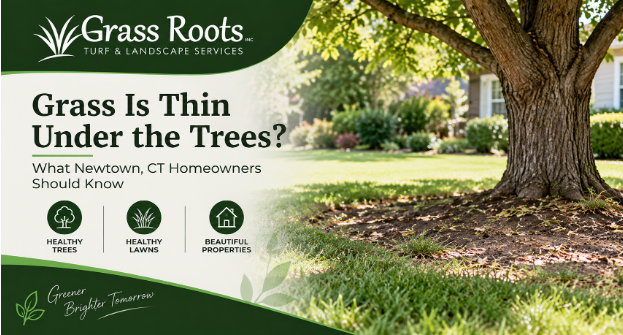
A lawn can look thick, green, and healthy across most of the yard but become noticeably thin underneath mature trees. You may see bare soil, weak grass, moss, or areas where new seed grows for a short time and then disappears. It is easy to assume that these spots simply need more seed or fertilizer, but the real problem can be more complicated.
For Newtown, CT homeowners, understanding why grass struggles beneath trees can help prevent repeated treatments that do not address the actual growing conditions. Shade is an obvious factor, but competition for water, tree roots, soil conditions, and routine maintenance can all influence how well turf performs.
Shade Is Only Part of the Problem
Grass needs sunlight to produce energy and maintain healthy growth. Under a large tree canopy, the amount and duration of direct sunlight reaching the ground can be significantly reduced.
However, not every shaded area behaves the same way. One section may receive several hours of morning sun, while another remains shaded for most of the day. Buildings, fences, and neighboring trees can reduce light even further.
Before trying to repair thin grass, observe the area at different times of day. Understanding how much sunlight actually reaches the lawn provides a better starting point than repeatedly adding seed.
Trees and Grass Compete for Water
A mature tree and the grass growing underneath it share the same general area for resources. Tree roots can extend well beyond the visible canopy, meaning the competition is not limited to the space immediately surrounding the trunk.
During dry periods, grass underneath trees may struggle even when other parts of the lawn remain relatively healthy. Simply adding more water is not always the right solution because the needs of the tree, turf, soil, and drainage conditions all have to be considered.
Companies such as Grass Roots Inc work with lawn and landscape conditions as a whole, which is important because a struggling section of turf may be connected to several environmental factors rather than one isolated problem.
Soil Conditions Can Make Thin Grass Worse
Soil beneath established trees can become difficult for turf for several reasons. Repeated foot traffic may compact the soil, while extensive tree roots can leave limited space for grass roots to develop.
Compacted soil can reduce the movement of air and water into the root zone. If grass roots remain shallow or weak, the lawn may become more vulnerable to heat and dry conditions.
Soil conditions also vary from property to property. Instead of assuming every thin area needs fertilizer, it can be more useful to consider soil structure, drainage, pH, nutrient needs, and other site conditions first.
Why Adding More Seed May Not Solve It
When homeowners see bare areas, reseeding is often the first response.
New grass may initially appear, especially when moisture and temperatures are favorable. But if the underlying conditions have not changed, that grass may gradually thin again.
This creates a frustrating cycle: seed, water, wait, see improvement, and then discover another bare patch months later.
Homeowners considering Lawn care services in NEWTOWN CT can benefit from looking at why turf is struggling before deciding which lawn-care approach makes sense for that particular area.
Fallen Leaves Can Reduce Light Even Further
Autumn leaves are another factor that can affect grass underneath trees.
A light layer may not cause an immediate problem, but a thick covering of wet leaves can block sunlight and hold moisture against the turf. If leaves remain in place for an extended period, the grass underneath may become stressed.
Regular leaf management helps keep the lawn exposed to available sunlight and air. At the same time, avoid aggressive raking or digging around mature trees because surface roots can be vulnerable to damage.
Mowing Habits Matter in Shaded Areas
Grass growing in challenging conditions should not automatically be treated exactly like turf in full sun.
Repeatedly cutting already weak grass too short can reduce the amount of leaf surface available for photosynthesis. Scalping uneven ground near exposed tree roots can also damage both the turf and potentially the tree.
Mowing practices should therefore reflect the type of grass, season, weather, and individual site conditions rather than relying on one approach for every part of the property.
Sometimes the Better Solution Is Less Grass
Not every part of a yard has to support a dense lawn.
If an area receives very little sunlight and grass repeatedly fails despite appropriate care, homeowners may want to consider whether turf is the best long-term use of that space.
Depending on the property, alternatives could include suitable shade-tolerant plantings, properly selected groundcovers, or mulched landscape areas. Any changes around established trees should be planned carefully to avoid damaging roots or piling material against tree trunks.
A Professional landscaping company in SHERMAN CT can also evaluate how lawn areas, trees, planting beds, drainage, and other landscape features work together rather than treating every bare patch as an isolated turf problem.
Look at the Whole Area Before Treating It
Before deciding what to do, examine the entire problem area. Ask how many hours of sunlight it receives, whether water collects or disappears quickly, whether the soil is heavily compacted, how close the grass is to major tree roots, and whether the problem changes throughout the year.
Also pay attention to unusual symptoms. Significant discoloration, widespread turf loss, pest activity, tree decline, or drainage problems may require a more specific assessment.
Final Thoughts
Thin grass underneath trees does not automatically mean a lawn is poorly maintained. Trees naturally change the environment around them by affecting sunlight, moisture, root space, and soil conditions.
For Newtown homeowners, the key is to understand why the grass is struggling before repeatedly adding seed, fertilizer, or water. Sometimes improved lawn practices can help. In other situations, adjusting the landscape may provide a more practical long-term solution.
A healthy property is not necessarily one with grass growing in every possible spot. It is one where the lawn, trees, soil, and landscaping are managed according to the conditions they actually have.